Moderate
Home energy in West Virginia: prices, net metering and rebate status
West Virginia electricity and gas both cost less than the national average. Your utility sets your rate, solar credit follows a fair-value rule, and a HOMES rebate pilot started in August 2026.
By VoltHearth Editorial Team Updated 6 min read
- Electricity price
- 15.39¢ per kWh
- Natural gas price
- $13.80 per Mcf
- Pick your supplier
- No, utility supplies you
- Net metering
- Yes, fair-value credit
At a glance
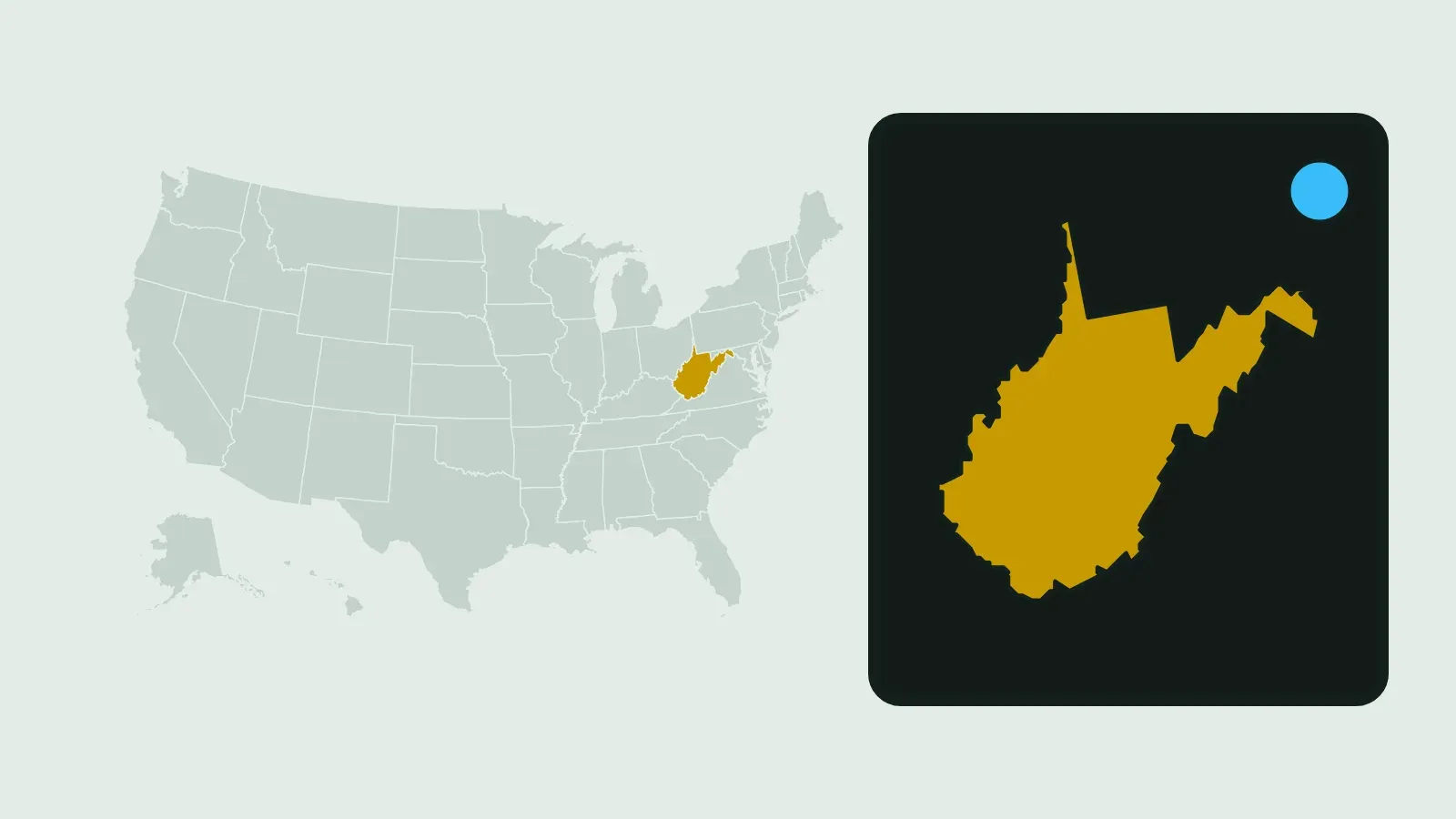
West Virginia households paid an average of 15.39¢ per kWh for electricity in 2025, about 11% below the national average, and $13.80 per thousand cubic feet for natural gas, about 10% below it. EIA reports no energy-only electricity sales in West Virginia in 2024, so your utility sets your rate. State law has the Public Service Commission (PSC) set a fair-value credit for net-metered solar. The state's HOMES rebate pilot launched in August 2026, and its HEAR program was still in development.
West Virginia at a glance
What West Virginians pay for electricity and gas
The U.S. Energy Information Administration (EIA) reports statewide averages: total residential revenue divided by kilowatt-hours sold, so delivery charges and fees are inside the figure. Your own rate depends on your utility, so treat these as a yardstick, not a quote.
| Energy | W. Va. 2025 | W. Va. 2024 | U.S. 2025 |
|---|---|---|---|
| Electricity (¢ per kWh) | 15.39 | 15.07 | 17.23 |
| Natural gas (dollars per Mcf) | 13.80 | 15.26 | 15.34 |
At 15.39¢, a month with 1,000 kWh of use comes to about $154. West Virginia electricity rose about 2% between 2024 and 2025 (15.07¢ to 15.39¢), while the gas average fell from $15.26 to $13.80 per Mcf. One Mcf holds roughly 10.37 therms, so $13.80 per Mcf is about $1.33 per therm. The kWh, therm and ccf guide explains the units on your bill.
Who sells you electricity
EIA's 2024 state electricity profile for West Virginia lists 32,990,570 MWh of retail sales, all of it from full-service providers and none from energy-only providers. The utility that delivers your power also sells it to you, and the PSC regulates its rates. Appalachian Power is one such utility. The rate structures guide explains the parts of a utility bill.
Solar panels and what the grid pays you
West Virginia Code section 24-2F-8 sets the framework. The PSC must adopt a rule requiring utilities to pay customer-generators a rebate or discount for net-metered generation at a "fair value" the Commission determines, and it must make sure the tariffs do not shift costs to other customers in the same class. The statute also tells the PSC to open a general investigation into net metering and interconnection rules.
Electric utilities generally offer net metering first come, first served, under a standard tariff, until customer-generator capacity reaches 3% of the utility's in-state customer peak demand from the prior year. At least 0.5% of that is reserved for residential customers. Cooperatives, municipal utilities and utilities with fewer than 30,000 residential customers are only under PSC consideration, not a requirement. The statute's own wording on "shall offer" and "may offer" is inconsistent, so ask your utility whether it is accepting new systems.
As a sample of how a tariff looks, Appalachian Power's 2026 West Virginia net metering guide (Revision 2.0, effective February 1, 2026) lists a 25 kW AC maximum for residential accounts and refers to Tariff N.M.S. for charges and conditions. It says terms and fees are subject to revision as the PSC approves. It does not state the credit rate, so get that from the tariff.
Home energy rebates
The West Virginia Office of Energy runs the state's Home Energy Rebate programs: HOMES for whole-home efficiency work and HEAR for appliances. When it announced a public input session in August 2024, it said about $88 million of federal money was expected for state residents.
A news report dated August 9, 2026 on the office's announcement says a HOMES pilot has launched for a select group of homes in southern West Virginia, working with three community action agencies. The office is taking applications from eligible residents statewide, but projects do not start until the pilot ends and HOMES is available in all counties. The same report says HEAR is still in development with no launch date, and it gives no rebate amounts. Check energywv.org before you act, and read the HOMES and HEAR guide for how the programs work.
Who to call
- Electricity rates and net metering tariffs: the Public Service Commission of West Virginia.
- Home energy rebates: the West Virginia Office of Energy, at energywv.org.
- Your own credit rate and tariff: your utility, which can name the schedule on your bill.
Quick answers
Can I choose my electricity supplier in West Virginia?
Not in practice. EIA reports that all of West Virginia's 2024 retail electricity sales came from full-service providers, with none from energy-only providers. Your utility delivers and sells your power.
Does West Virginia have net metering?
Yes, under West Virginia Code section 24-2F-8: utilities pay customer-generators a fair-value rebate or discount set by the PSC, up to a 3% capacity cap. Terms depend on your utility's tariff.
Are West Virginia home energy rebates available now?
Partly. A HOMES pilot launched in August 2026 for a select group of homes, and applications are open statewide, but projects do not start until HOMES is available in all counties. HEAR is still in development.
How does West Virginia gas compare with the U.S. average?
EIA's 2025 average for West Virginia households was $13.80 per Mcf against $15.34 nationally, and down from $15.26 in 2024. Your own rate depends on the gas utility serving you.
Sources
- EIA — Electric Power Annual, Table 2.10, average price by state
- EIA — Average residential natural gas price by state
- EIA — West Virginia state electricity profile (retail sales by provider type, 2024)
- West Virginia Code § 24-2F-8 — Net metering
- Appalachian Power — West Virginia net metering guide, 2026
- State of West Virginia — Office of Energy public input session on home energy rebates (August 2024)
- Buckhannon Record Delta — West Virginia Office of Energy launches HOMES pilot (August 9, 2026)
Prices are EIA statewide averages. Facts on this page were checked against these sources on November 19, 2026. The rebate pilot status comes from a news report on the Office of Energy's announcement, not from the office's own page. Net metering terms and rebate programs change; confirm with your utility, the PSC and the Office of Energy before you act.
Read next
-
Bill guide
Net metering
How exported solar power is credited on a bill, how net billing differs, and where to find your rule.
-
Credits and rebates
HOMES and HEAR rebates
State-run DOE rebates and the May 2026 rule changes. Status differs by state.
-
State reading
Virginia
15.28¢ per kWh; mostly utility supply; SCC net metering rules; home rebates not available yet.