High
Home energy in Delaware: prices, who sells you power and what is open
Delaware electricity costs about the national average, supplier choice covers Delmarva Power customers, and solar exports earn kilowatt-hour credits. Here is how each part works.
By VoltHearth Editorial Team Updated 5 min read
- Electricity price
- 17.15¢ per kWh
- Natural gas price
- $15.97 per Mcf
- Pick your supplier
- Delmarva customers
- Net metering
- Yes, up to 25 kW
At a glance
Delaware households paid an average of 17.15¢ per kWh for electricity in 2025, just under the national average, and $15.97 per thousand cubic feet for natural gas, a little above it. The Public Service Commission says supplier choice is open to Delmarva Power customers for electric service. State law sets net metering for residential solar up to 25 kW. The pages we could read from the state energy office do not say the HOMES and HEAR rebates are open.
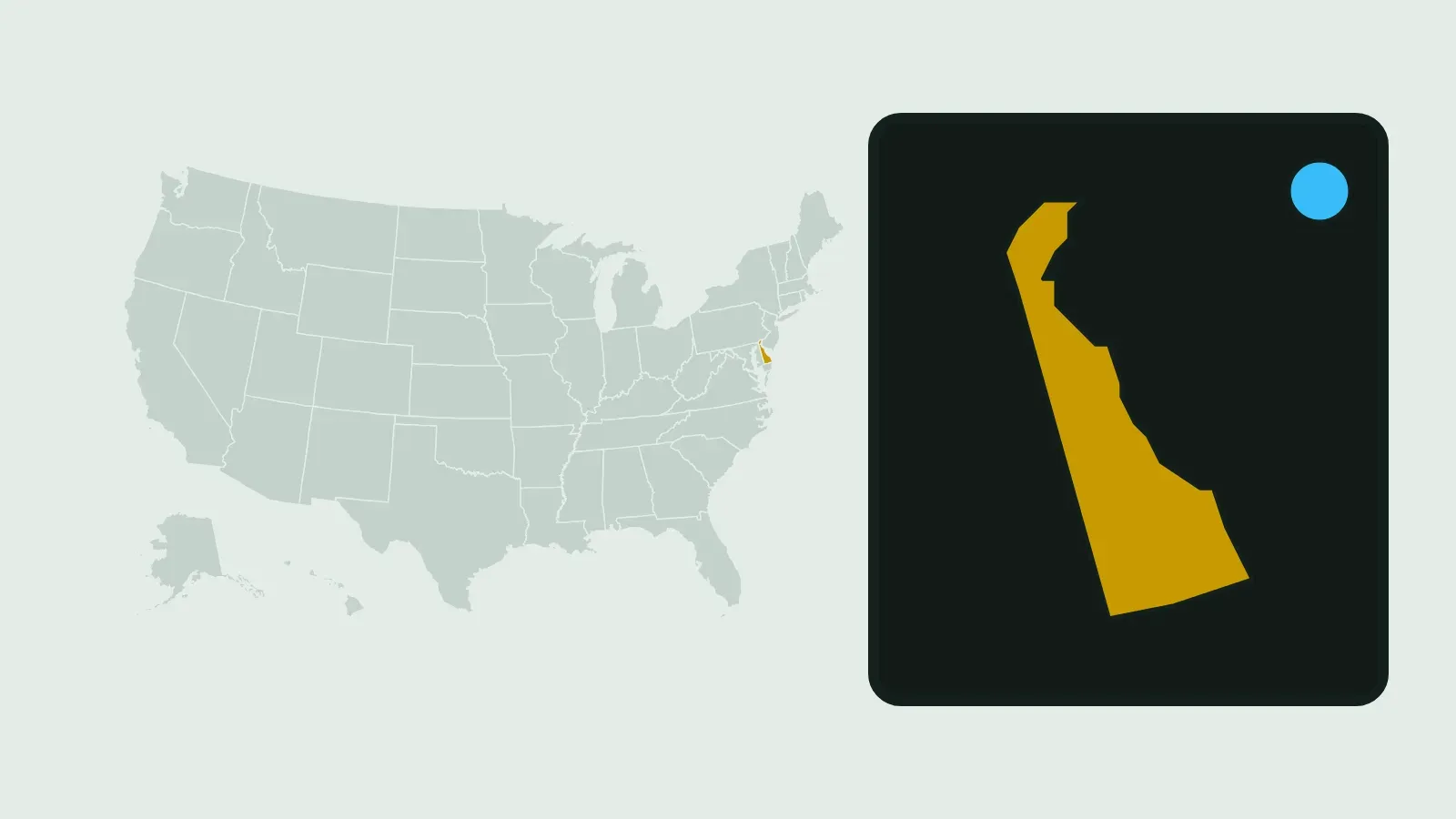
Delaware at a glance
What Delawareans pay for electricity and gas
The U.S. Energy Information Administration (EIA) reports statewide averages: total residential revenue divided by kilowatt-hours sold, so delivery charges and fees are inside the figure. Your own rate depends on your utility, supplier and season, so treat these as a yardstick, not a quote.
| Energy | Delaware 2025 | Delaware 2024 | U.S. 2025 |
|---|---|---|---|
| Electricity (¢ per kWh) | 17.15 | 16.57 | 17.23 |
| Natural gas (dollars per Mcf) | 15.97 | 14.78 | 15.34 |
At 17.15¢, a month with 1,000 kWh of use comes to about $171.50. Delaware electricity rose about 3.5% between 2024 and 2025 (16.57¢ to 17.15¢) and ended 2025 a fraction of a cent below the U.S. average. Gas rose about 8% (from $14.78 to $15.97 per Mcf) and sits about 4% above the U.S. average. One Mcf holds roughly 10.37 therms, so $15.97 per Mcf is about $1.54 per therm; the kWh, therm and ccf guide explains the units on your bill.
Who sells you electricity
Delaware separates delivery from supply for some customers. The Public Service Commission (PSC) says choice of a third-party electric supplier "is currently available to Delmarva Power customers for electric only." Delmarva Power stays responsible for delivering electricity to your home, even when you buy supply from someone else. It owns the lines and responds to outages. The same PSC page does not say whether customers of the Delaware Electric Cooperative or of municipal electric companies can switch suppliers, so ask your utility.
- If you are a Delmarva Power customer: you can compare supplier offers against the utility's own price to compare.
- If you are not: confirm with your co-op or city utility whether supply is open to competition before you sign anything.
- Natural gas: the PSC lists Delmarva Power and Chesapeake Utilities as the regulated gas utilities.
Plans differ on fixed or variable price, contract length and cancellation fees. The retail choice guide shows how to compare them on the total bill at your own usage.
Solar panels and what the grid credits you
Delaware has a statewide net energy metering law in Title 26 of the Delaware Code (section 1014). It credits customers in kilowatt-hours for excess production, and credits left at the end of a year carry over to later billing periods. Residential systems can be up to 25 kW for customers of Delmarva Power, the Delaware Electric Cooperative and municipal electric companies. The law says a system should be designed to produce no more than 110% of the host customer's expected electricity use.
The credit value changed on January 1, 2024. Each monthly credit is now valued at the volumetric (per kWh) parts of the supply and distribution charges, leaving out the societal benefits program charges. Credits cannot reduce fixed monthly customer charges. The customer keeps the renewable energy credits unless they were transferred by contract.
The federal tax credit for rooftop solar ended for systems finished after December 31, 2025, so the credit on your bill now carries more of the payback. What happened to 25C and 25D explains what is left.
Home energy rebates
The DNREC State Energy Office will run two federally funded programs: HOMES, rebates for whole-home efficiency work, and HEAR, rebates for electric appliances and equipment. Its overview page lists $33.0 million for each program and says the full application went to the Department of Energy in August 2024.
The status text on DNREC's pages is out of date. A page published October 16, 2024 says launch was expected "once funding is received later this year." A second DNREC page, last modified October 14, 2026, still says launch was expected in the second quarter of 2025. We found no DNREC page saying the programs are open. The earlier page described HOMES rebates of $2,000 to $8,000 per home and HEAR rebates of $500 to $8,000 by measure, aimed at lower-income households. Treat those as planning figures. Check DNREC before you start work you hope a rebate will cover. How the programs work elsewhere is in the HOMES and HEAR guide.
Who to call
- Electricity and natural gas: the Delaware Public Service Commission regulates Delmarva Power and Chesapeake Utilities. It says it controls distribution services under its regulatory control.
- Rebates and energy programs: the State Energy Office at the Department of Natural Resources and Environmental Control (DNREC).
- Efficiency programs: the Energy Efficiency Advisory Council, which includes the State Energy Office, utilities and the Public Advocate's office, helps design utility efficiency programs.
Rate requests before the commission
Two rate requests show up on the PSC's home page. Delmarva Power applied to raise base rates by a proposed $67.8 million (Docket No. 25-1555); the PSC posted notices of public comment sessions on August 19 and September 23, 2026. On the gas side, the PSC reported in July 2025 that Chesapeake Utilities customers faced their first base gas rate increase in nine years, with the Commission acting on June 18, 2025.
A proposal is not a final rate. Look up the docket on the PSC site for the outcome and the effective date, and compare it with the tariff on your bill. The rate structures guide explains how base rates and riders fit together.
Quick answers
Can I choose my electricity supplier in Delaware?
The Public Service Commission says choice is currently open to Delmarva Power customers for electric service. Delmarva still delivers the power. If you get service from a co-op or city utility, ask it whether you can switch supplier.
Does Delaware have net metering?
Yes. State law sets net energy metering with kilowatt-hour credits, and residential systems can be up to 25 kW for Delmarva Power, Delaware Electric Cooperative and municipal customers. Since January 1, 2024, credits are valued at the per-kWh supply and distribution charges, excluding societal benefits program charges.
Are Delaware home energy rebates available now?
We found no DNREC page saying so. Its pages still show an earlier launch expectation, in the second quarter of 2025. Check the State Energy Office page before you start work you hope a rebate will cover.
Why did my Delmarva Power bill change?
Delmarva Power has asked the PSC to raise base rates by a proposed $67.8 million (Docket No. 25-1555). Your bill also changes with usage, season and the supply price. Check the docket and your tariff.
Sources
- EIA — Electric Power Annual, Table 2.10, average price by state
- EIA — Average residential natural gas price by state
- Delaware Public Service Commission — Customer electric choice
- Delaware Public Service Commission — Home page and rate notices
- Delaware Code, Title 26, Chapter 10 — Net energy metering
- DNREC — Home energy rebate programs
- DNREC — Inflation Reduction Act programs
Prices are EIA statewide averages. Facts on this page were checked against these sources on November 19, 2026. Rebate programs, rate cases and utility policies change; confirm with your utility, the Public Service Commission and the State Energy Office before you act.
Read next
-
Bill guide
Net metering
How exported solar power is credited on a bill, how net billing differs, and where to find your rule.
-
Credits and rebates
HOMES and HEAR rebates
State-run DOE rebates and the May 2026 rule changes. Status differs by state.
-
State reading
Maryland
19.53¢ per kWh; supplier choice; net metering under a 3,000 MW cap; rebates await DOE approval.