Low
Home energy in South Dakota: prices, utility territories and solar
South Dakota electricity and gas sit well below the U.S. average. You cannot pick a supplier, there is no net metering, and VoltHearth could not confirm home rebate status from a state page.
By VoltHearth Editorial Team Updated 5 min read
- Electricity price
- 13.32¢ per kWh
- Natural gas price
- $9.86 per Mcf
- Pick your supplier
- No, set territories
- Net metering
- No net metering
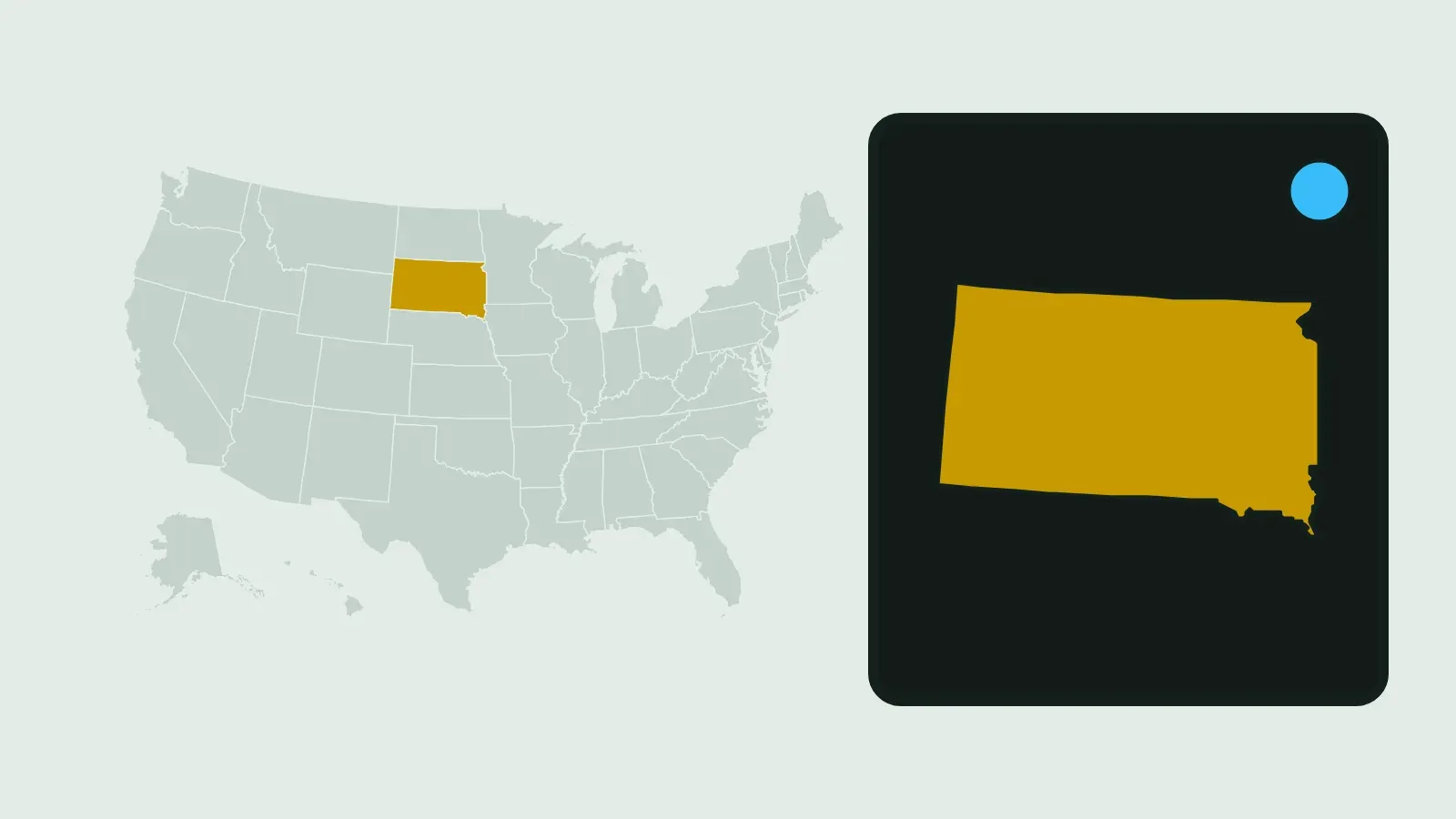
At a glance
South Dakota households paid an average of 13.32¢ per kWh for electricity in 2025, about 23% below the national average, and $9.86 per thousand cubic feet for natural gas, about 36% below it. Utilities hold the exclusive right to serve retail customers in territories the Legislature set in 1975, so there is no supplier choice. The Public Utilities Commission says the state does not compensate solar at a net metered rate. State rebate status could not be confirmed.
South Dakota at a glance
What South Dakotans pay for electricity and gas
The U.S. Energy Information Administration (EIA) publishes a statewide average for each fuel: what utilities and suppliers billed households, divided by what they used. Delivery charges and fees are inside the number. Your own rate depends on your utility and the season, so read these as a yardstick, not a quote.
| Average price | 2024 | 2025 |
|---|---|---|
| Electricity, South Dakota (¢ per kWh) | 12.86 | 13.32 |
| Electricity, U.S. (¢ per kWh) | 16.48 | 17.23 |
| Natural gas, South Dakota (dollars per Mcf) | 9.32 | 9.86 |
| Natural gas, U.S. (dollars per Mcf) | 14.50 | 15.34 |
At 13.32¢, a month with 1,000 kWh of use comes to about $133.20. The South Dakota average rose about 4% between 2024 and 2025. Gas rose about 6%, from $9.32 to $9.86 per Mcf. One Mcf holds roughly 10.37 therms, so $9.86 is about $0.95 per therm. The kWh, therm and ccf guide explains the units on your bill.
Who sells you electricity
The Public Utilities Commission (PUC) says utilities have the exclusive right to provide retail electric service in territories set by the Legislature in 1975. You buy electricity from the utility that holds your address, and you cannot shop for a different supplier. Rates are set by the utility, and the PUC regulates them only for the six investor-owned utilities: Black Hills, MidAmerican, Montana-Dakota, NorthWestern, Otter Tail and Xcel. It does not regulate the rates of cooperatives or municipal utilities.
- Investor-owned utility: rate changes go through the PUC, and the tariff is public.
- Co-op or city utility: the PUC does not set these rates. Ask the utility for its rate schedule and who approves changes.
For how a rate turns into a bill, see the rate structures guide.
Solar panels and what the utility pays you
The PUC's solar FAQ, dated October 10, 2024, says plainly that South Dakota does not compensate solar generation at a net metered rate. Its compensation page says the Legislature has repeatedly concluded that mandatory net metering is not in the public interest. That page is undated.
What you can do instead is sell power to your utility. The PUC says regulated utilities must interconnect with and buy power from small solar facilities if the generator wants that and accepts the terms. The minimum rate is the utility's avoided cost, the expense it would otherwise incur to generate or buy the power. For facilities under 100 kW, investor-owned utilities must file their rates with the PUC for approval.
The federal tax credit for rooftop solar ended for systems finished after December 31, 2025. What happened to 25C and 25D explains what is left.
Home energy rebates
VoltHearth could not confirm the status of South Dakota's HOMES and HEAR rebate programs from a state source. The PUC does not run them, and DOE's program page, last updated July 8, 2026, lists no states and sends readers to their state energy office.
Until a state page says otherwise, treat any contractor claim that South Dakota rebate money is available as unconfirmed, and ask the state to confirm it in writing before you start work. The programs are explained in the HOMES and HEAR guide. Utility rebates, where they exist, are covered in the utility rebate guide.
Who to call
- Rates of the six investor-owned utilities: the South Dakota Public Utilities Commission.
- Co-op and city utility rates: the utility itself.
- Solar interconnection and buyback: your utility, which sets the small-generator rate.
Quick answers
Can I choose my electricity supplier in South Dakota?
No. The PUC says utilities hold the exclusive right to serve retail customers in territories the Legislature set in 1975. Your address decides your utility.
Does South Dakota have net metering?
No. The PUC says the state does not compensate solar generation at a net metered rate. Utilities must buy power from small solar facilities at no less than their avoided cost if the generator wants that.
Are South Dakota home energy rebates available now?
VoltHearth could not confirm that from a state source. Ask the state energy office whether the HOMES and HEAR programs exist in South Dakota before you plan work around them.
Why is South Dakota's electricity price below the U.S. average?
EIA's 2025 average for South Dakota households was 13.32¢ per kWh against 17.23¢ nationally. The figure includes delivery charges and fees. Your bill shows how your own rate is built; the electric bill guide walks through the lines.
Sources
- EIA — Electric Power Annual, Table 2.10, average price by state
- EIA — Average residential natural gas price by state
- SD PUC — Electric laws FAQ (August 31, 2026)
- SD PUC — Solar FAQ (October 10, 2024)
- SD PUC — Compensation for small generators
- U.S. Department of Energy — Home energy rebates programs
Prices are EIA statewide averages. Facts on this page were checked against these sources on November 19, 2026. Rebate status could not be confirmed from a South Dakota source; confirm with your utility and the state before you act.
Read next
-
Bill guide
Net metering
How exported solar power is credited on a bill, how net billing differs, and where to find your rule.
-
Credits and rebates
Utility rebates
Where to look for your utility's rebates and what to confirm before you buy.
-
State reading
North Dakota
11.82¢ per kWh; utilities set rates, no retail choice found; net metering unclear; rebates not launched.